The
Thuja Tree is best known as numerous garden shrubs, mostly dwarf forms.
The tallest rarely grows above 30 feet high. These trees have regular,
graceful conical forms that make them valuable as high hedge trees. Our
remedy, Thuja Occidentalis, is the larger species of the tree that may
grow to 200 feet. The wood is used for fencing and palings, as a light
roofing timber. The fresh branches are much used in Canada for besoms
(tools for space cleansing), which have a pleasing scent. The leaves and
twigs yield a camphor-like essential oil that can be distilled from the
leaves and used to expel intestinal worms. The foliage is rich in
vitamin C. The American Indians used it to treat scurvy. It has been
used in fevers, rheumatism, dropsy, coughs and to induce or hasten
menstrual flow. The leaves, made into an ointment with fat, are a
helpful local application in rheumatism. An injection of the tincture
into venereal warts is said to cause them to disappear. The Canadians
have used the cones for violent pains.
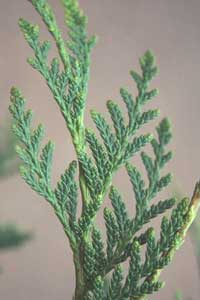
Thuja occidentalis
Trees
convey the notion of growth, strength and longevity, grandeur, survival
and incorruptibility. Due to its longevity, incorruptible resin and
evergreen leaves, Thuja has been associated with immortality (Tree of
Life). For this reasons it is planted in graveyards and has its place as
the funeral tree in the Mediterranean region. It is the tree of life
but also the tree of death, a tree for all seasons. This is also the
mental picture of
Thuja occidentalis.
The name Thuja is a Latinized form of a Greek word meaning ‘to
fumigate,’ or thuo (‘to sacrifice’), as the fragrant wood was burnt by
the ancients with sacrifices. The Greek word Thujas means “raving
women”. The Greek word Thusia means “a burnt offering”, a sacrifice.
The Sycotic Miasm
Thuja
is a strongly sycotic remedy characterised by overproduction and
excess. The picture of the sychotic state is one where individuals may
have inflated egos with an ability and tendency towards performance. The
response to the feeling of being out of balance is to overcompensate.
They feel like something is wrong with them, that there’s something
broken, brittle or weak within themselves, so they attempt to cope by
covering it up.
We often read that Thuja patients
become secretive, manipulative and defiant, but actually that’s not
normally the case. I for one love to treat a Thuja patient! They’re some
of the nicest people I’ve ever met. They always take their remedy
exactly as they’re supposed to. Why? It’s because they suffer lots of
guilt as they cover up their perceived failings and try and be all
things for all people. They fear that their weaknesses may be exposed.
They play many roles according to their company and surroundings and
model themselves on people in their lives who they admire and hide
behind that mask.
Characteristics and Pathology
Antidotes oral contraceptives, HRT, fertility treatments, chemotherapy, and steroid therapy.
Following
recurrent infections e.g. e-coli infections, Chlamydia, trichamona,
candida, fungal infections, herpes simplex, herpes genitalia, human
papilloma virus and shingles.
NBWS Chicken Pox
Self
abuse – because they have the sense that life is hostile, they go out
into the world and abuse themselves with drugs, alcohol, excessive
tea/coffee drinking, tobacco, sexual excesses.
Worse from sweets, onion, garlic, alcohol, chemicals (sulphur and mercury)
Birth trauma, head injury – there’s a resistance to being born.
Sensitive to cold/wet
It
affects all organs that are ovoid (shape of the tree/bush) – polyps,
ovaries, testes, pancreas, spleen, endocrine glands, thyroid and the
pathology characteristically includes excess of discharges.
Fleshiness
– increased water retention so they put on weight. There may be vast
changes in weight (morning to night), they swell when they travel or go
to the seaside.
Slow metabolism: A Thuja
patient in health is splendid to see. They are very handsome men and
very beautiful women with the perfect, athletic body. They create a mask
through the body itself and perfection through plastic surgery. Great
attention is paid to diet, eating and drinking where it can reach
obsessive levels. Then as the sycotic miasm takes hold, the metabolism
slows down, they have a tendency towards true obesity. They take on an
oval form. The trunk becomes fat. They have thin legs and arms, extra
breasts if it’s a man and overhanging abdomen.
The
contraceptive Pill causes lymphatic oedema so they gain weight and are
never able to get rid of it. With HRT the breasts grow, or one may grow
and the other may not, either side, and they become overweight.
Sometimes the weight may be another mask, as in Calc where the weight is
another shell. Thuja is also good for infertility where indicated.
High cholesterol
Poly cystic kidneys
Cystic fibrosis of the pancreas – it’s a pancreatic remedy.
Nails:
Thickened, deformed, overgrowth (sil), undulations of the nail,
elongated stripes and ridges that you can feel and see. Transverse
corrugation, going out and coming back – often as a reaction to stress
and it’s laid down in the nail bed.
Skin:
Facial skin can be course with an Orange peel appearance. Old acne scars
may be evident – it’s a great acne remedy (Med). Hair starts to fall
out. Skin starts to peel off. Like the tree, it’s like dandruff. They
lose hair from parts they don’t want to lose hair from – eyebrows, pubic
hair – the older Thuja particularly. Sweat on uncovered parts. Sweat
when asleep. Smelly feet, armpits and groin. Nature conspires to make
them ugly nearly!
There can be Eruptions and
growths, warts and tumours of all sorts, particularly of the face.
Specific red tumours, red nodules, papillomas, port wine stains are
common. They may have a broad fleshy nose, red veins and capillaries on
the nose. There may be conspicuous temporal arteries because there can
be high blood pressure. The remedy picture turns up many endocrine
disorders such as Cushings disease and Addison’s disease. There may be
pigmentation of the skin from hormone therapy, the pill or HRT or
alternatively vitiligo where patches of skin have lost pigmentation. The
picture also contains scars and keloids.
A
very important feature is fungal infections. There may be a history of
antibiotic treatment. Mycosis may be part of the picture where fungal
infection occurs through inhalation of fungal spores or where fungus
manages to pass the resistance barrier of the skin and cause infection
(Sepia, Bas). Hormonal conditions bringing on repeated bouts of Candida,
or there can be thrush from the pill.
Mental and Emotional Thuja, Themes and Possibilities
Thuja
types are very secretive and commonly perceived as deceitful as a
result. The deceit is not apparent in the Thuja patient. They are some
of the nicest people you’ll ever meet. They believe themselves to be
fragile. They often maintain that their health, or their body, will
always let them down, so may present as hypochondriac.
These
patients can be very religious. Here is a good indication of the
extremes of the sycotic miasm. They have an image of themselves as being
clean-living and upright members of society, yet they have low self
esteem. This may be covering hidden sexual desires about which they are
guilt-ridden. Thuja women have a great fear of pregnancy, often feel as
though they are pregnant, and this brings about feelings of guilt. This
is in contrast to the Medorrhinum patient who is overly sexual. Sankaran
sees Thuja coming from a situation which demands rigidity of thinking,
so it suits them to engage in activities that lend themselves to this,
such as practicing strict religious beliefs.
Social
security lies in adhering, or at least appearing to adhere to, religious
norms. Inside however the person feels brittle or fragile. In his
manner he looks straight and fixed and his ideas and views do not allow
for any freedom of thinking. Yet from inside there is always a fear of
being exposed and his whole cover breaking down; this makes him stiff
and cautious in the presence of strangers. The fall from grace is
symbolised in dreams of falling, from which he wakes up with a fright.
Sankaran finds that one of the main indications of the remedy is a
feeling of being frail or fragmented – a feeling of weakness within
oneself, that something is “wrong” with oneself. These patients think
that food and alcohol are bound to cause them problems and that their
system cannot take things such as drugs, allergens, emotional stress or
exposure to a draft of air. They try to avoid all such things and
attempt to keep themselves covered to avoid exposure to the same. These
avoidances only reinforce the fear and this vicious cycle is not broken,
making Thuja one of the main remedies for neurosis, with obsessive
compulsive tendencies and fixed ideas and behaviour patterns.
In
the emotional sphere the feeling of fragility is manifest in the fear
of losing face in society. The person can believe that he has a certain
image in society of being a religions, upright, clean, honest person,
free from human failings such as dishonesty, sexual temperament etc.
Thus he presents an elevated picture of himself as he is afraid that any
slip on his part might reveal the real person or the “bad” part of him,
which he has tried so hard to cover up. In this “bad part” lies his
dishonesty, sexual desires (which can even be for close relatives), his
immoral or irreligious feelings. If this is discovered, he will fall
from his imagined elevated position and will be finished. Thus his
survival depends on a complete cover up, and there is tremendous anxiety
about being exposed.
The Thuja person is secretive
and talks to the physician as if sharing a secret. He is ever conscious
of the presence of other people, especially strangers. There is also a
feeling of floating in the air. He dreams of falling from high places –
representing his fear of falling from his elevated position.
Borland
states that “all Thuja patients are truthful, scrupulous in everything
they do” – i.e. they are so deceptive you will think they are being
honest. Thuja is also a Silica look-alike. Silica can degrade into
Thuja. Thuja is more deceptive however, they may have a hidden or
secretive, private life. Thuja is an actor, a chameleon remedy, a
different person in different circumstances. They are morally correct,
can be closed and present as perfectly symmetrical with not a hair out
of place.
They aim at perfection Nothing can be
wrong, so they can’t be spontaneous. They also like to be invisible.
They have delusions of being like glass – again going back to the theme
of fragility and transparency – they don’t want to be seen. They seek to
be isolated. There’s a sense of alienation within them and they can
feel incompatible with their environment. Aurum is very close to Thuja.
They try to conceal what they can’t suppress. What they can’t conceal
becomes sexual.
They come across as being happy, even
when sad. They can suppress emotion/grief, much farther than Nat Mur.
In the midst of their sadness they are soliciting for sympathy, which
people don’t give them. And when they don’t get the sympathy they are
resentful. Where awful traumas have taken place and the grief is very
deep, they can fall into coma. In labour they didn’t want to come into
the world and as growing children they try and make the mother pay for
bringing them into the world with confrontational behaviour.
They
can be hypersensitive to remarks/opinions because those reflect
discomfort with themselves. If questioned about their beliefs, they feel
like they are being attacked at an identity level, at their very core.
They feel brittle. As a survival mechanism, since they perceive life as
hostile, they build up this world around themselves. They can be haughty
and overbearing. At their best they have poise and presence, but it can
appear as pompous. They can be very condescending. Lycopodium can
degenerate into Thuja.
Nothing must threaten their
dignity. They can be very serious, devoid of humour and can’t take a
joke against themselves. True feelings are often concealed beneath a
charming veneer. Oiliness (in the wood) is a theme – they can grease
their way up any social ladder. We call these people Sycophants –
they’re slippery and too charming. There’s a mask of politeness and
language, but it’s lifeless. Their diction is too perfect so it
distances them from other people. They desire solitude, feel separate,
secretive and they resist intrusion.
In their manner
they are poised, hurried, agitated or impatient. There’s never enough
time for Thuja. They intentionally try to slow down time because they
feel like they’re on a carousel and they’re trying to get off. As a
practitioner you have to look at the glandular area and all the
endocrine organs.
The spiritual stimulus of sycosis
is part of the psychological and spiritual evolution of the individual.
Through the action of sycosis the person becomes aware of duality,
realising he is not just a physical being. There’s an awareness of the
animal in them and a conflict of energies, one of which is wholesome and
the other quite opposite. There’s a loss of identity which comes with
this. Then there’s a tendency to judge the self through negative
energies that are determined by the shadow. Then building up a personal
being blighted by images determined by the unconscious and thrown up as a
different identity.
David Lilley’s picture of the
Sycotic Home is invaluable in understanding this remedy. Sexual abuse is
a common theme in these cases. There’s a loss of identity from the
abuse and the negative images from the unconscious, and a new persona
being born from this negativity. They will say things like “I am bad”,
“I am abused” “I am wicked”. The sycotic has to descend into hell,
confront the shadow and in that conflict he must rise up and resurrect.
They are not destroying anything, they are bringing the two things
together (like Sil) and there is a reformation to transcend. Sycosis in
Greek means “standing up” rising up. It also means resurrection and
transcendence.
It is easy to see the transition from
Calc Carb to Thuja – Calc has a fear of life so he creates a shell.
Thuja has a mask. The fear of the incarnation experience is equal in
both. Both have a fear of insanity and germs. Thuja is always washing
his hands – need to cleanse. Calc has the feeling that life is awful.
With Thuja there is the need to hide, to be invisible.
Sycosis
is transmittable (STD) so it is highly contagious through promiscuity.
In the home there is sycotic energy. Where there is sycotic energy and
there is lack of education, then possibly you have big families, where
fundamentalism is practiced. They have lots of children – this is a
status thing – but there are fears of infertility. Role models are cold,
calculating, cruel and manipulative, and the child is given contrasting
messages. Everything is permeated by deceit, hidden, subterfuge,
clandestine, secret, private, nasty, weird and ugly, because very often
they are projecting the exact opposite image to that which they are
indulging in.
Masquerading with puritanical piety,
the child is being fed messages that sex is dirty and disgusting, while
the very things that they are condemning they are indulging in. They
externalise their crimes and iniquities, implanting them in the ears of
others. It’s like Jimmy Swaggart, impassioned on the pulpit, where he
proclaims that there were prostitutes at home. He announces the very
things he desires and he condemns it from the pulpit.
These
parents are talking about dirt and filth. They never talk about sex.
The more the energy is suppressed the more energy it has. All the
messages in the family are unpredictable, underhand, under cover. A
Silicea born into this environment has the subjectivity to grow away
from this situation, but Thuja doesn’t. Thuja has a loss of identity.
There’s suppression from all around them. Big factors include low
income, overcrowding in homes, absent mother or marital strife,
antisocial father (antisocial personality type). The mother in this case
may be the victim. There may be deviousness with the conflict that
ensues. The patients dream of confrontation and war. Sometimes the child
is sent away from the home which intensifies the lack of identity.
There
can be a history of abuse – physical, emotional, sexual. There also may
be excessive parental control from authoritarian parents and neglectful
suppression from pious puritanical parents. They develop intrusive
thoughts of the obsessive compulsive type. They emphasise the
relationship with the mother (Thuja, Med – all the sycotics). Where the
mother is predatory, the perpetrator, these are the worst possible
cases. The mother is also an accomplice. Or the mother is passive, not
involved, turns her back; the intrusion of the father is not believed.
The mother is unable to help as she herself is a victim. Incest is
common. There may be apparent discrepancy between the behaviour at home
and the behaviour in the workplace/school, or, a husband who is
wonderful at work and horrible at home.
Loss of
identity follows along with emotional problems. Children are in fear
that the footsteps are going to stop outside her door. They are beaten,
subjugated, humiliated. An awful state of over-adaptation takes place.
How
do they survive? Through delusions. Even if you don’t know about the
abuse you can prescribe on the delusions. They are trapped, caged
(Cimic). There’s a pattern of submission, compliance and then
resignation. Their destiny is in the hands of someone who is
perpetrating these terrible things and they have no control. They are
suspicious, mistrustful, they lack faith and are sceptical. Thuja has no
trust in anybody.
The upbringing may have been
extremely critical with destructively judgemental parents. Negative
comparisons are made. There is often a Lycopodium dad who’s not lifting
the children up, but plumping himself up instead. Authoritarian parents
who approach parenthood with authority – children should be seen and not
heard; you may look but you may not touch – it makes the child cringe,
go inwards and conceal.
Or you may have indulgent
parents – where the child is born with an aversion to the mother from
the word go – from breastfeeding, there can be oppositional defiance
problems. They have the worst tantrums, both in the adult and child. He
punishes mother with the silent treatment. As an adult they still do it.
He thinks his mother emasculated him. The mother is the victim; the
victim of her own passion. When not in the energy of the family
situation, he rescues. He is the victimiser and then he rescues.
With
neglectful parents – love and care is not flowing or consistent and is
unpredictable, where it only comes from behaviour of a certain type. The
child begins to think that life is unpredictable, cruel and cold, that
everything is about manipulation. He has to fight and manipulate and be
devious to get what he wants. He is born with the sycotic feeling of
being stained so this situation perpetuates the feeling that he is
unworthy of their care and attention – unlovable.
Thuja
loses identity, goes into herself and develops a quiet, silent,
internal life which gradually becomes more warped due to the sexual
sycotic energy. Suppressed sexual energy becomes deviant. She will make
love to her herself with her imagination. At the same time there can be a
sense of sexual inadequacy in adulthood. It can become a weird and
twisted picture. There is a desperate need for love.
Children
go inwards and become desperately compliant – the model child – out of
that emerges the immaculate adult – always dressed correctly, does
things correctly; extra vigilant because they don’t know what’s going to
happen next. They become hypersensitive to sounds and smells. They can
become androgynous (asexual, genderless). They can become very sensitive
to pheromones. Tactile, sensitive children (autism).
Fetishism
can be part of the picture or a perverse sex life. They can be
hypersensitive to everything that encroaches on the body. There are
themes of indiscriminate discipline, indiscriminate punishment and
indiscriminate love. When love is indiscriminate and when punishment is
indiscriminate then you have problems. The father applies indiscriminate
punishment according to his will (not the child’s behaviour) and the
mother gives him contrasting messages because no matter what he does,
she loves him and indulges him.
How can a child react
to that? There’s no consistency. They become superstitious, fatalistic,
resigned. The sense of morality disappears. The consequence of actions
means nothing. There’s an erosion of the moral core. Consequences are
irrelevant at a young age. There’s a sense of learned helplessness
(Lac-can). She skulks around hoping to be invisible – the glass factor –
hence the connection between Thuja, Sil, Lac-can. There’s humiliation
and degradation leading to an inferiority complex.
Sexual
shame is another theme which can come from puritanical parents giving
the child messages that sex is dirty. There’s tremendous sexual energy
in the Thuja person so that when it’s suppressed, it becomes distorted.
An emotional picture emerges from the underlying theme of stained,
stigmatised, blighted, soiled, defiled, inferior – and so “something is
wrong with me” leading to the belief that if people knew the real person
they wouldn’t be liked. I have got something that I must hide. I will
suppress what I can. What I cannot suppress I will conceal.
Another
theme that emerges is fixity. They dwell on past disagreeable events,
anger and resentment is present on the surface. For a person who is
totally shattered and torn apart during psychotherapy, think Thuja,
because it comes up into the consciousness, doesn’t resolve and becomes
fixed.
Children who have been abused have a tendency
to traumatise themselves, perhaps at times leading to Anorexia and
Bulimia. Persistent washing of hands is a clue, as there’s an
inclination to compulsion which is symbolic and ritualistic. They have a
need to cleanse themselves of that feeling of being stained or tainted
and get rid of a sense of guilt and to wash away a sense of shame. A
bath will not work for Thuja. They need a shower. Lac-can, Thuja.
There’s also a fear of contagion. The feeling of being out of touch with
reality creates an obsessive compulsive anxiety. Thuja is anally
retentive. As part of oppositional defiant disorder in certain children,
there is a refusal to pass stool -which ties in with the bashful stool
syndrome of Thuja. There’s rigidity in persistent thoughts and
inflexibility of the emotions. Routine is strict. Everything must go
according to his will and not be in the least opposed.
They
can be rigid and dogmatic in their opinions – they like to bend your
ear with their opinions, but they are not in the least bit interested in
your opinions. They can be immaculate in presentation, going through
every little detail about their disease – Ars, Calcarea
They’re
sensitive to criticism and contradiction. In fact, there can be fury
from contradiction. There is sensitivity to trifles and tendency to
worry about insignificant things. They have terrible concerns about
trivial things whilst neglecting the bigger issues.
They
are consummate lovers, suitors and can manipulate a woman into bed
better than most remedies. Conquest is not the issue, but rather it’s
sex for sex only, the act only.
Survival Strategies in Thuja After Abuse
OCD
Adopt
the stance of the model child coupled with vigilance – conforming. “I
am bad” – they take it on board and have a dual impression of the abuser
– a means to disassociate the care-taker from the abuser. They feeling
guilty for the abuse they are receiving. They can hold conflicting
pictures, through deep rationalisation and delusion, of the abuser. This
can only be achieved by assaulting their true identity. They have to
make themselves bad. They then get to have some degree of control. “If I
am bad then I am being abused with some justice. If I am good the abuse
will stop, so if I comply with what is being demanded of me, give in,
yield, I’ll be alright”. The problem here is that the personality being
created is wrapped around the concept of being wicked. Those feelings of
hatred that are so profound in Thuja, suppressed deep inside, increase
their sense of wickedness and badness. Sometimes they are sexually
stimulated by the abuse. They believe this is confirmation that they are
wicked.
Creating an alter-ego : Multiple
personalities can emerge where some will carry pathology and others will
not in the same individual (also Plat).
Disassociation
– They project themselves out of the body. They make their body numb
and they feel nothing while the abuse goes on. Delusions he is floating
on air, mind and body is separated, abstraction of the mind.
Depersonalisation can occur. The cause of the disassociation has past,
but they use the disassociation to deal with all personal traumas later
in life – false persona, fragile, brittle. Amnesia as a result of abuse
is very big.
Control freaks – chaos where the control is imposed by something else. They become histrionic (hysteria).
Abuse of drugs and alcohol later in life -addiction – gambling.
Being busy all the time, workaholics. Industrious, Mania for work
Self
mutilation – feeling of control at last, emotional pain substituted for
physical pain, self punishment, taking out anger on herself (anger for
her abuser)
Excessive masturbation after sexual abuse. Self love, to sooth and to comfort.
Kleptomania
– it engenders the same feeling they get when they are fearing the
abuse – adrenaline rush, intensity of the emotion.
Avoidance of intimacy. Seeking religious support and fundamentalism.
Seeking sex, compulsively.
Paedophilia
There’s
a loss of inner control. Then the external control goes. These
compulsions assume another identity – Delusion: I am under the influence
of other powers.
Acknowledgment:
When
I was doing my research for this article I listened to David Lilley’s
lectures on Thuja and Medorrhinum. David has helped me to truly
understand the Thuja in me and my wonderful Thuja patients. Thank you
for your wonderful insights.


